Notary fees on older properties: what legal charges actually impact your acquisition budget?
Written by: The Editorial Team
Publié le :
Modifié le :
6–9 minutes


Written by: The Editorial Team
Publié le :
Modifié le :
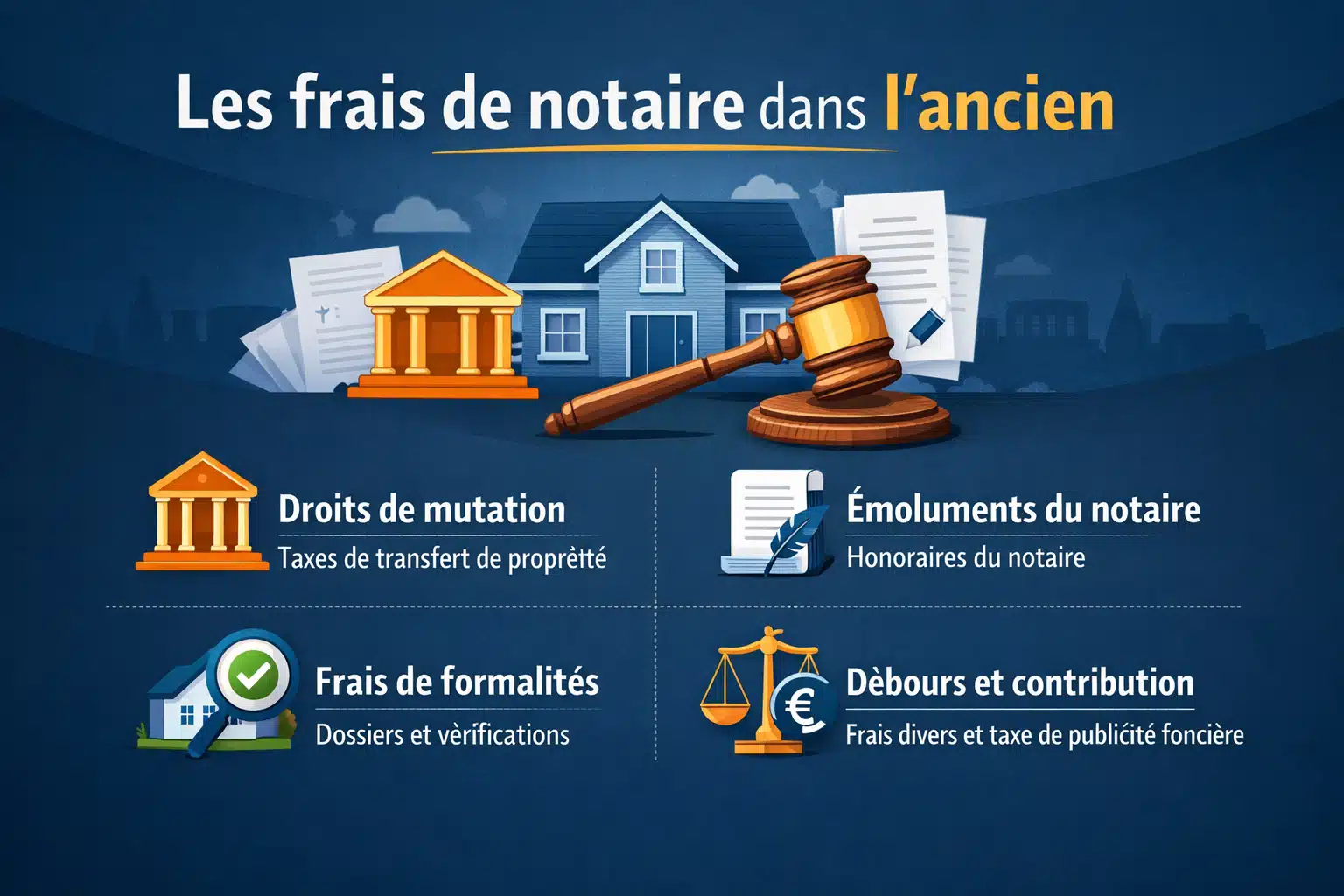
Purchasing an old property represents a major investment that requires anticipating all associated expenses. Notary fees for old properties generally amount to between 7% and 8% of the purchase price, or approximately 15,000 to 20,000 euros for a property worth 250,000 euros. These fees are composed mainly of transfer rights (taxes), notary fees and disbursements. Understanding the exact breakdown of these charges allows you to optimize your budget and avoid unpleasant surprises at signature.
Contrary to popular belief, notary fees do not correspond solely to the notary's compensation. They group together several distinct expense categories that represent variable amounts depending on the nature and price of the property.
Transfer rights, also called registration rights, constitute the majority of notary fees. These taxes, paid to the State and local authorities, represent approximately 5.80% of the sale price in most departments. This taxation includes the departmental tax (set between 3.80% and 4.50% depending on the department), the municipal tax (1.20%) and assessment and collection fees (2.37% of departmental rights).
These rights apply to the net seller price, but also to certain ancillary items such as furniture if their value is not clearly itemized in the deed of sale. It is therefore strategic to clearly distinguish moveable property in the purchase agreement to reduce the taxable base.
The notary's actual compensation, called fees, is strictly regulated by a national scale and represents approximately 1% of the purchase price. This tariff works on a sliding scale, which means that the rate decreases as the property price increases. For a property worth 200,000 euros, the fees amount to approximately 2,000 euros, while for a property worth 500,000 euros, they reach approximately 4,000 euros, clearly demonstrating this degressive principle.
Since 2016, notary fees are negotiable for properties whose price exceeds 100,000 euros, with a possible discount of up to 20% on the portion of fees proportional to the price. This negotiation remains limited, however, and only concerns a fraction of the total fees.
Disbursements represent the expenses advanced by the notary on behalf of the buyer : planning documents, cadastral extracts, administrative document requests, surveyor fees if necessary. These expenses vary depending on the complexity of the case but generally amount to between 400 and 800 euros.
Added to these disbursements are the real estate security contribution (formerly called land publicity tax), fixed at 0.10% of the sale price, as well as formality fees that cover administrative steps carried out by the notary with various administrations.
| Property price | Transfer rights (5.80%) | Notary fees | Disbursements and miscellaneous | Total notary fees | Total percentage |
| 150 000 € | 8 700 € | 1 650 € | 500 € | 10 850 € | 7,23% |
| 200 000 € | 11 600 € | 2 000 € | 550 € | 14 150 € | 7,08% |
| 300 000 € | 17 400 € | 3 000 € | 600 € | 21 000 € | 7,00% |
| 400 000 € | 23 200 € | 3 800 € | 700 € | 27 700 € | 6,93% |
| 500 000 € | 29 000 € | 4 500 € | 800 € | 34 300 € | 6,86% |
The difference between notary fees in the secondary market and in new properties proves to be considerable and can significantly influence your purchase decision. In new real estate, notary fees represent only 2% to 3% of the acquisition price, against 7% to 8% in older properties.
This difference is explained by the application of reduced taxation on new properties. Instead of transfer duties, the buyer only pays a reduced property publicity tax of 0.715% of the price. The notary's fees and expenses remain similar, but the absence of heavy departmental duties significantly reduces the final bill.
A new property at 250,000 euros generates approximately 6,000 to 7,500 euros in notary fees, while an old property at the same price costs between 17,500 and 20,000 euros. This saving of 10,000 to 13,000 euros can be reinvested in renovation work or constitute a more substantial personal contribution.
One of the most effective techniques consists of clearly distinguishing the value of furniture in the deed of sale. Transfer duties apply only to the price of the real estate, not to furniture. By explicitly valuing equipment (fitted kitchen, furniture, appliances) in a separate deed, you reduce the taxable base.
However, be careful to remain consistent: a fitted kitchen can legitimately be valued between 3,000 and 8,000 euros depending on its quality, but obvious overvaluation would attract the attention of the tax authorities. This method allows you to save approximately 7% on the value of itemized furniture.
Since the 2016 reform, you can obtain a discount of up to 20% on the notary's proportional fees. This negotiation applies only to the variable portion linked to the price (approximately 1% of the price), not to expenses or transfer duties.
This negotiation takes place directly with the notary's office when signing the agreement or at the latest before the authentic deed. Do not hesitate to compare several offices and request a detailed quote.
Calculation errors, although rare, can occur in the establishment of notary fees. It is recommended to request a detailed statement and to check in particular the following points:
Not all departments apply the same transfer duty rate. If the majority applies a rate of 3.80% for the departmental tax, some departments have opted for an increased rate of 4.50%. This difference of 0.70 percentage points can represent several thousand euros on a significant transaction.
Departments applying the increased rate include notably Indre, Morbihan, Côtes-d'Armor and Mayenne. On a property worth 300,000 euros, this increase represents an additional cost of approximately 2,100 euros. This information deserves to be integrated into your reflection if you are hesitating between two properties located in different departments.
Acquisition fees often represent the « forgotten budget » of first-time buyers. Anticipating these expenses from the start of your real estate project avoids disappointments and allows you to build a realistic financing plan.
Banking institutions rarely include notary fees in the amount of the main real estate loan. These fees must generally be financed by the buyer's personal contribution, alongside the 10% minimum contribution often required.
For a property worth 250,000 euros in the existing market, you must therefore have approximately 42,500 to 45,000 euros of personal contribution : 25,000 euros of standard contribution (10%) plus 17,500 to 20,000 euros of notary fees. Some banks accept financing notary fees via a supplementary loan, but often under less favorable conditions than a traditional real estate loan.
This constraint explains why many first-time buyers turn to new construction or to assistance programs such as the zero-rate loan, which helps reduce the initial personal contribution requirement.
Certain particular situations entitle you to exemptions or reductions in notary fees. Rural revitalization zones (ZRR) benefit from a total exemption of mutation rights for primary residence acquisitions, subject to resource and residence commitment conditions.
Acquisitions of social housing by their occupants also benefit from a reduced tax regime. Similarly, certain family consolidation operations or transfers may benefit from reduced rates, particularly in the context of gift-sharing or inheritance.
You should inquire precisely with your notary about your eligibility for these schemes, which can generate substantial savings but remain unknown to the general public.
A thorough understanding of notary fees constitutes a determining element in the success of your real estate acquisition project. These charges, far from being incidental, represent a budget equivalent to several years of savings for many households.
Integrating these fees into your financing plan from the start saves you disappointments and allows you to negotiate in better conditions with sellers and banking institutions. Do not hesitate to use online simulators to obtain a precise estimate based on your department and the target property price, then request a detailed quote from several notaries to compare their negotiable fees.
Finally, keep in mind that these fees, though substantial in the existing market, are often accompanied by a purchase price lower than new construction and a location generally more central. The choice between existing and new must therefore be made based on an overall view of the project, integrating all financial, asset and personal parameters.
The editorial team
Passionate about overseas real estate, we follow daily the tax incentive schemes in the DOM-TOM. Our objective: to give you the keys to invest peacefully in Guadeloupe, Martinique, Reunion, Mayotte, French Guiana or Polynesia, with clear information and practical advice.